
Last Saturday, David and I had the opportunity to present three sessions at the California Association of Teachers of English (CATE) conference.
Like most conferences, the day went quickly. Teachers moved between sessions. Conversations continued in hallways. Ideas were exchanged in those brief moments between presentations when educators compare what is working in their classrooms and what still feels unresolved.
But one session in particular stayed with me.
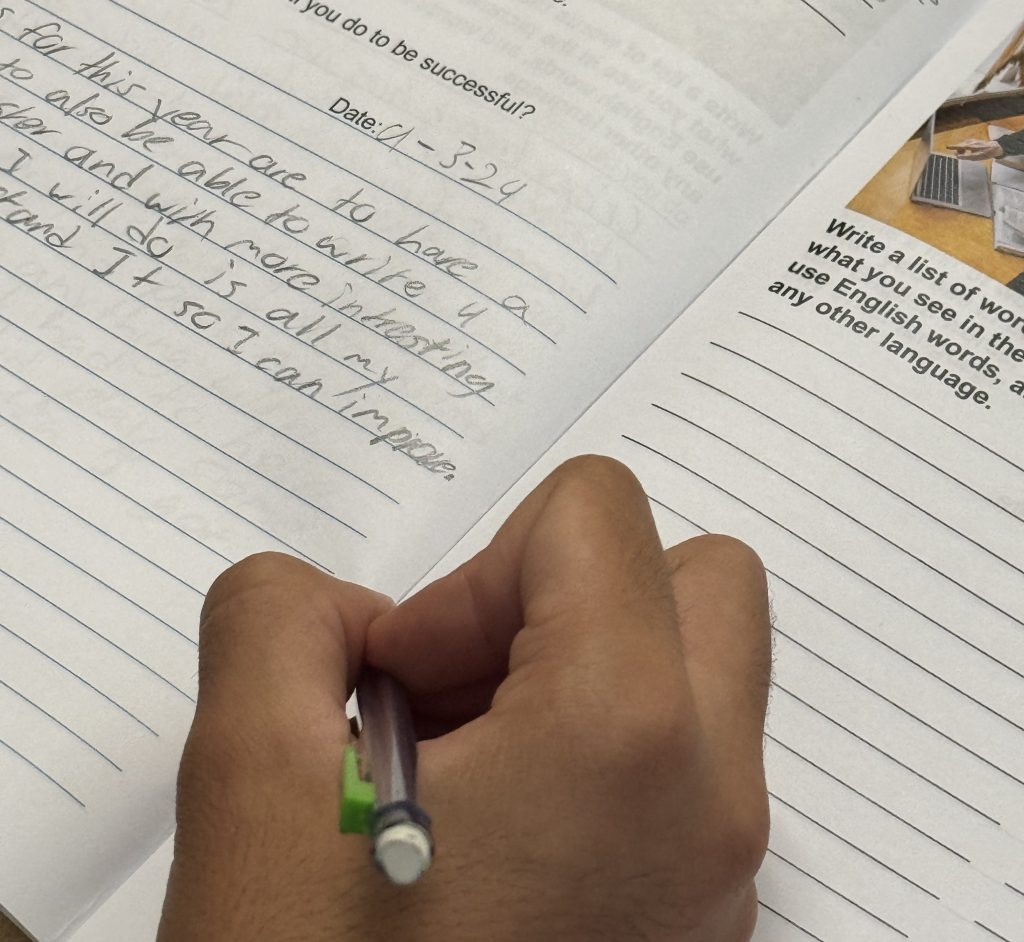
It was the session based on Bridging Languages, the writing workbook we created for high school multilingual learners.
Where the Work Began
That work goes back several years now. It grew out of several months of action research, David’s doctoral research, a deep engagement with the academic literature, David’s experience as a multilingual learner himself, and my own experience teaching multilingual students in secondary classrooms.
At the time, we were trying to solve a practical problem: how do we help multilingual students develop confidence and skill in academic writing without reducing instruction to formulaic sentence frames or oversimplified scaffolds?
Teachers working with multilingual learners know the tension well. On one hand, students need support navigating the linguistic complexity of academic writing. On the other hand, overly rigid scaffolds can unintentionally limit students’ voice, reasoning, and ownership of their ideas.
Our goal with Bridging Languages was to design writing instruction that respected both realities. We wanted structures that supported language development while still allowing students to engage in authentic thinking and argument.
In many ways, that work was the foundation for everything we have done since.
When the Focus Shifted
Over the past year, much of our focus has shifted toward artificial intelligence and the Four Pillars: collaboration, problem solving, critical thinking, and communication. Those conversations have taken us into new spaces — helping teachers think about responsible AI integration, student use of generative tools, and how emerging technologies intersect with writing instruction.
But standing in that room last Saturday, talking again about multilingual writers, reminded me of something important.
The Throughline: Access
Our work has always been about access.
Access to language.
Access to academic thinking.
Access to the kinds of learning experiences that allow students to see themselves as capable writers and thinkers.
AI conversations can sometimes move quickly toward efficiency or innovation. Those are important conversations. But if we are not careful, it becomes easy to assume that new tools automatically benefit all students in the same way.
They don’t.
Students who are still developing academic language, students receiving special education services, and students navigating multiple linguistic and cultural contexts often experience these tools differently. The opportunities are real, but so are the risks of widening gaps if the tools are implemented without intentional design.
AI and the Responsibility of Design
Presenting that session reminded me that our message about AI and the Four Pillars has to remain rooted in the same commitment that shaped Bridging Languages in the first place.
When we talk about AI-based instructional strategies, we mean strategies that work for all learners.
That includes multilingual learners who are building academic language while engaging in complex thinking. It includes students who benefit from structured support as they develop confidence in writing. It includes classrooms where teachers are balancing rigorous expectations with the reality of diverse learning needs.
In many ways, AI makes that responsibility even greater.
When designed thoughtfully, AI can help students generate ideas, clarify language, and deepen reasoning. It can act as a scaffold that supports students as they develop their own voice as writers.
But that only happens when the instruction around it is intentional.
The work cannot begin with the tool. It has to begin with the learner.
Still Grounded in the Same Work
Last Saturday was a good reminder of that.
It reminded me that the throughline in our work has never been technology, frameworks, or even writing instruction alone. The throughline is the belief that every student deserves access to the kind of learning that challenges them to think, communicate, and grow.
As our work continues to evolve, that commitment remains the same.
That belief continues to shape the work we do through 4 Pillars Learning Lab. Whether we are talking about writing instruction, AI integration, or the development of collaboration, problem solving, critical thinking, and communication, the goal remains the same: designing learning experiences that expand opportunity rather than narrow it.
Because when we say that our approach to AI and the Four Pillars is designed for all learners, we mean it.
And that work started long before AI entered the conversation.
It started with students learning to find their voice on the page.
~ Amelia
 Write2Succeed